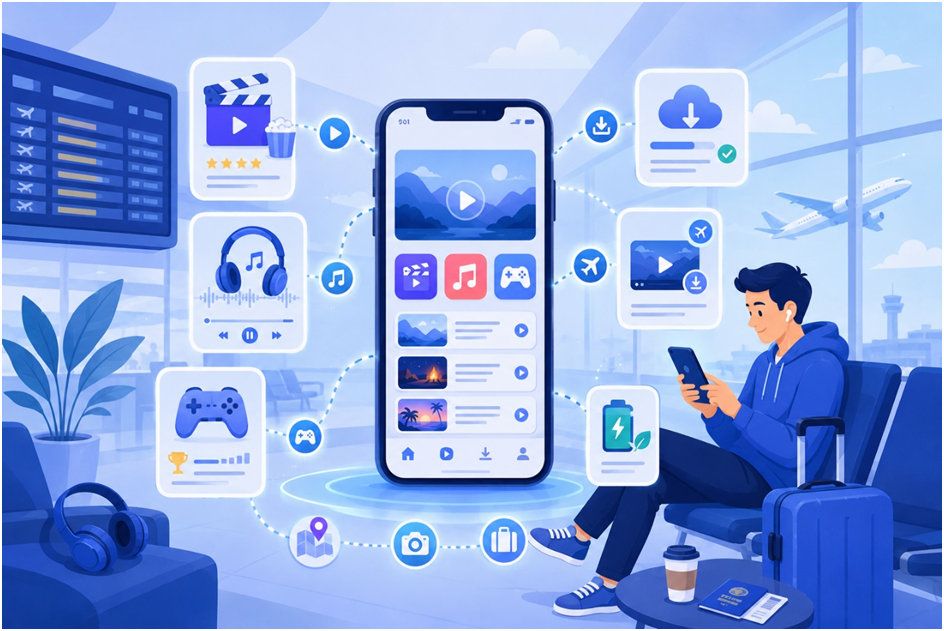
Not long ago, getting bored was simply part of traveling. Whether it was waiting at a bus stop, sitting at a railway station, spending hours at an airport, or riding on a long bus journey, there was often very little to do. People carried books, newspapers, or magazines, listened to music on simple devices, looked out the window, or talked with family and friends to pass the time.
Today, travel feels very different for most people. Almost everyone carries a smartphone, and that small device can keep us entertained throughout the journey. A long wait no longer has to feel wasted. People watch movies, listen to music, enjoy podcasts, read e-books, play mobile games, or scroll through social media while traveling. Some even use the time to edit travel photos, learn about their next destination, or plan the rest of their trip.
This change did not happen all at once. Better smartphones, faster internet, and a growing number of travel apps have slowly changed what people expect from their journeys. Mobile entertainment is no longer just a way to avoid boredom, it has become an important partof the modern travel experience. From planning a vacation to relaxing in a hotel after a busy day of sightseeing, digital entertainment now fits naturally into almost every stage of a trip.
In this article, we will explore how mobile entertainment is reshaping the modern travel experience. We will look at the technologies behind this change, the benefits they offer, the challenges they bring, and practical ways travelers can enjoy entertainment without missing the real experiences that make every journey memorable.
Why Mobile Entertainment Matters More During Travel Than Anywhere Else
Travel is exciting, but it also comes with a lot of waiting. Whether you are standing in a long line at the airport, sitting on a bus, riding a train, or waiting for your flight, there are many moments when there is nothing much to do. In the past, people simply accepted these moments as part of the journey. Today, mobile entertainment has changed that.
With just a smartphone, travelers can watch movies, listen to music, enjoy podcasts, read e-books, or play mobile games. What once felt like wasted time can now become a chance to relax, learn something new, or simply enjoy a favorite form of entertainment.
Mobile entertainment also helps people feel less stressed while traveling. Even a well-planned trip can come with unexpected situations, such as:
- Long security lines at airports.
- Delayed flights, trains, or buses that make the journey longer than expected.
- Finding your way in an unfamiliar place, especially in another city or country.
- Keeping track of boarding times, gate changes, or travel schedules.
- Worrying about lost luggage or missed connections.
During moments like these, something familiar can make a big difference. Watching a favorite TV show, listening to a relaxing playlist, or playing a simple mobile game helps many travelers stay calm and makes waiting feel much easier. For families, mobile entertainment is even more valuable. A young child may find it difficult to sit still during a long flight or road trip. Educational games, cartoons, storybooks, and children’s videos can keep them entertained, making the journey more enjoyable for both children and parents.
In the end, mobile entertainment is about much more than avoiding boredom. It helps travelers make better use of their time, stay relaxed during unexpected delays, and enjoy the journey just as much as the destination.
The Evolution of Travel Entertainment
Go back two decades and travel entertainment meant physical objects:
- Paperback novels
- Portable CD players
- Printed guidebooks
- The occasional in flight movie shown on a shared screen
Airlines controlled what passengers watched, and travelers had little say beyond bringing their own book or magazine.
The shift began gradually with personal media players, then accelerated sharply once smartphones combined a screen, a music library, a camera, and eventually a full streaming catalog into a single device already sitting in every pocket. What used to require several separate gadgets now happens through one.
This evolution did not just change what people watch or listen to. It changed who controls the experience. Instead of relying on whatever an airline or hotel provided, travelers now curate their own entertainment before they even leave home, downloading exactly what they want for the exact hours they expect to be without reliable connectivity.
Streaming Services on the Move
Streaming has become the default expectation for travelers, even in places where connectivity is far from perfect. Someone might start a series at home, pause it at the airport gate, and pick it up again from a hotel room on the other side of the world without losing their place.
What makes this possible is not just faster networks but smarter apps. Most major streaming platforms now let users download episodes and films directly to their device before departure. That single feature quietly solved one of travel’s oldest frustrations: unreliable Wi-Fi at exactly the moment entertainment is needed most.
Why Downloading Content Before a Trip Matters
Downloaded content is especially useful during:
- Long flights
- Train journeys
- Road trips
- Airport waiting times
- Hotel stays with unreliable Wi-Fi
- International travel with expensive mobile data
A traveler heading on a twelve-hour flight might spend the night before downloading:
- Two or three films
- A handful of podcast episodes
Gaming has quietly become one of the most common ways travelers pass time, particularly during short bursts of waiting such as boarding queues or train platforms. Unlike a film or a book, a mobile game can be picked up and dropped in seconds, which suits the unpredictable rhythm of travel far better than longer form entertainment.
Cloud gaming has added another layer to this. Rather than needing a powerful device, travelers can now stream console quality games through their phone, provided the connection holds steady. Two habits have become common as a result:
- Keeping a lighter, fully offline game installed as a backup for when signal drops
- Leaning on simple puzzle or trivia games for children, since they need no headphones or quiet environment
These small adjustments matter a great deal on a crowded train or in a busy airport lounge.
Podcasts and Audiobooks for Travelers
Not every traveler wants a screen in front of their face for hours at a time, and this is where audio entertainment has found its place. Podcasts and audiobooks let people keep their eyes free, whether that means watching the scenery on a train journey or simply resting during a long flight.
Audio content also fits naturally into travel planning itself. Many travelers now listen to destination-specific podcasts before a trip, using them almost like a modern substitute for the printed guidebook.
How Audio Entertainment Enhances the Travel Experience
- Listen to destination-specific podcasts before a trip to learn about the history, culture, or local attractions.
- Enjoy the scenery during a train journey while listening to a podcast or audiobook instead of looking at a screen.
- Rest your eyes on long flights without giving up entertainment.
- Make road trips more engaging, especially for drivers who cannot safely watch a screen.
- Replace repetitive radio stations with audiobooks or carefully selected podcast episodes.
A history podcast about a city, played during the flight there, can shape how someone experiences that city once they land. Audiobooks solve a similar problem for road trips, where a driver cannot safely watch a screen but still wants something more engaging than silence or repetitive radio stations.
Social Media and Sharing Travel Experiences
Documenting a trip has become almost as central to the experience as the trip itself for many travelers. Short-form video, in particular, has changed how people capture and share moments, favoring quick, polished clips over the longer photo albums of the past.
This has created a small but noticeable shift in travel behavior. Certain viewpoints, cafés, and landmarks now draw crowds specifically because they photograph or film well, sometimes more than for their historical or cultural significance.
How Social Media Has Changed Travel
- Short-form videos have become more popular than traditional travel photo albums.
- Travelers often choose photogenic viewpoints, cafés, and landmarks because they look good in photos or videos.
- Many people now edit their content while traveling instead of waiting until they return home.
- Mobile editing apps make it easy to trim, caption, and polish videos within minutes.
Editing on the go has become part of the routine, with apps like InShot letting travelers trim, caption, and polish clips from a hotel room or even a train seat, rather than waiting until they are back home with a laptop.
Offline Entertainment for Limited Connectivity
Not every destination offers dependable wifi, and international data plans can be expensive or simply unavailable. This is exactly the gap that offline focused apps have grown to fill. Tools such as Vidmate, Snaptube, and TubeMate allow travelers to save video content in advance, so a long haul flight or a remote hiking trip does not mean hours of nothing to watch. Browsers built with offline access in mind, such as UC Browser, have found a similar niche among travelers who want to browse or save content before entering an area with weak signal, whether that is a mountain village or a transatlantic flight without wifi.
The common thread across these tools is preparation. A simple pre departure routine has become second nature for many frequent flyers:
- Download a few episodes or films the night before, not at the gate
- Save a couple of offline games in case cloud gaming or wifi fails
- Queue up a destination podcast so the trip starts before the plane even leaves
- Save any maps or guides that might be needed without signal
Travelers who follow steps like these tend to treat entertainment the way they treat packing a bag, something planned in advance rather than figured out in the moment when the signal has already dropped.
Entertainment for Families and Children While Traveling
Parents traveling with young children face a particular version of this challenge, since a bored child on a long journey affects everyone nearby, not just the family itself. Mobile entertainment has become one of the more practical tools for managing this, offering a controlled, familiar option in an unfamiliar environment.
Downloaded shows, simple games, and offline story apps tend to work best here, since they remove the risk of a dropped connection interrupting a show at exactly the wrong moment. Many parents now build a small library of downloaded content specifically for travel days, separate from what their children watch at home.
There is also a wellbeing conversation worth having here. Most parents recognize that screens are a tool for specific moments, such as takeoff and landing or a delayed connection, rather than a default state for the entire trip. The destinations themselves, after all, are usually the reason for traveling in the first place.
Most discussions about mobile entertainment and travel assume reliable connectivity, the kind found in major airports and well-covered cities where streaming simply works. That assumption holds up less often than people expect. Across rural stretches and countries where mobile data remains expensive or inconsistent, travelers face a different reality, one where entertainment cannot depend on a constant connection. This gap created real demand for a category of apps built specifically to bridge it. A few names come up again and again among frequent travelers.
Vidmate is probably the most familiar entry on this list, and for good reason. Anyone who has spent a night in a guesthouse with patchy wifi knows the drill: you find something worth watching, you are not sure the connection will hold tomorrow, so you pull it down while you can. Vidmate lets travelers do exactly that across a wide range of platforms, saving video and audio for the long bus ride or the overnight train ahead. For people moving through regions where signal comes and goes without warning, this is not a workaround. It is simply part of how the trip gets planned.
Spotify rounds out the audio side for travelers who already have their music library set up long before the trip starts. Downloading a playlist or a couple of albums before boarding means the soundtrack keeps running through a layover, a long bus ride, or a stretch with no signal at all, without needing to think about it twice. It is the kind of app most travelers already have installed, which is exactly why it slots so easily into a pre departure routine.
Netflixneeds little introduction at this point, and its download feature has quietly become one of the most used travel habits around. Loading up a couple of episodes before a flight or a long train ride means the entertainment is already sorted before the trip even begins, no searching for signal, no gambling on hotel wifi holding up. For a lot of travelers, this is the default now rather than the backup plan.
UC Browser folds the saving process directly into ordinary browsing, so there is no jumping between a browser tab and a separate app to hold onto something for later. It is a small detail, but on a trip full of small frictions, cutting out one extra step tends to add up by the end of a long travel day.
InShot rounds things out by handling the other side of the equation. Not everyone traveling is just collecting content to watch. A growing number are shooting their own footage , a sunset over a new skyline, a street market, a quick clip from the train window , and InShot gives them the tools to trim and polish that footage before it goes anywhere. It is a reminder that travelers today are rarely just passive viewers. Many of them are documenting the trip in real time, phone in hand the entire way.
Challenges and Responsible Mobile Entertainment Use
For all its benefits, constant access to entertainment carries a few real downsides worth acknowledging:
1. Missing the moment : Travelers can find themselves so absorbed in a show or a game that they miss the actual experience of the place they traveled to see, whether that is a scenic train route or the atmosphere of a new city.
2. Battery life : Heavy streaming and gaming drain a phone quickly, which becomes a genuine problem if that same phone is needed for boarding passes, maps, or hotel bookings later in the day. Many experienced travelers now carry a portable charger for this reason.
3. Digital wellbeing : A short period of screen free time, even during travel, tends to leave people with sharper memories of a trip. The traveler who spends an entire train ride through the countryside watching a show on their phone may arrive with fewer memories of the journey itself than the one who occasionally looked up.
Mobile entertainment has changed nearly every stage of the modern journey, from the planning that happens weeks in advance to the last stretch of a layover before boarding. It has turned dead time into usable time and given travelers far more control over how they spend the hours that used to feel like an obstacle between home and destination.
The technology itself is not the point, though. It is a tool, and like any tool, its value depends on how it gets used. The travelers who benefit most tend to be the ones who treat mobile entertainment as something that supports their trip rather than replaces it, reaching for a downloaded show during a delay but setting the phone aside once the destination itself comes into view.
In the end, a well planned trip still comes down to the same thing it always has: the places seen, the people met, and the moments that stay with someone long after the phone battery has died. Mobile entertainment simply makes the space between those moments a little easier to navigate.
1. Does using offline content apps actually help if I’m only traveling for a couple of days? Even on short trips, it makes a difference. A weekend trip still has a layover, a wait at security, maybe a delayed connection. Having a couple of episodes or a downloaded video ready means you’re not stuck refreshing a buffering screen for those twenty minutes.
2. Is it worth downloading content before I leave, or can I just stream once I land? Streaming once you land works fine if you know the wifi is good. But most travelers get caught off guard at least once, whether it’s a hotel with weak signal or a rural stretch with no data coverage at all. Downloading beforehand is just insurance against that.
3. Will short-form travel videos actually help me plan a trip, or are they mostly just for entertainment? Both, honestly. A lot of people start out just scrolling for fun and end up bookmarking a restaurant or a viewpoint without meaning to. It’s not a replacement for real research, but it’s a decent way to stumble onto things a guidebook would never mention.
4. Why does a recommendation feed show two friends completely different things for the same city? Because the algorithm isn’t really showing you “the city.” It’s showing you a version of the city shaped by what you’ve clicked on before. Two people with different scroll habits end up with two different maps in their head before they’ve even landed.
5. Are podcasts actually a good fit for travel, or do they just work better for daily commutes? They’re arguably even better suited to travel. A commute is short and predictable. A long flight or an overnight bus ride gives you the kind of stretch of uninterrupted time that a podcast or audiobook actually needs to land properly.
6. Does relying on a phone for entertainment mean people pay less attention to where they actually are? Sometimes, yes, and that’s a fair criticism. But it cuts both ways. A lot of travelers also use their phones to research, translate, or capture the place they’re in, so it’s not purely a distraction. It depends a lot on how someone chooses to use it.
7. Is it normal to download content even when I know I’ll probably have decent wifi anyway? Completely normal, and most frequent travelers do exactly that. It’s less about expecting bad connectivity and more about not wanting to think about it at all once you’re mid-trip.
8. Will video editing apps actually make a difference if I’m not trying to be a content creator? Yes, even casually. Most people aren’t building an audience, they just want a clip of a sunset or a street market to look decent before sending it to family. A quick trim and a bit of polish go a long way without needing any real skill.
