Swim jets, also referred to as counter-current swim systems, generate a powerful, continuous water current that allows swimmers to remain stationary while swimming against the flow.
This technology effectively transforms any residential pool into an endless swimming lane, making it ideal for fitness training, rehabilitation, and family recreation.
Understanding the mechanics behind swim jets helps users maximise their benefits and make informed choices about installation and usage.
Core Components of a Swim Jet System
A modern swim jet is far more than a simple nozzle.
It is an engineered assembly of several key parts that work together to produce a smooth, swimmable current.
The jet unit itself houses a motor and an impeller, which draw in pool water and accelerate it.
A separate control box, typically installed at least three metres from the water, manages power distribution, speed settings, and timing.
Mounting brackets and hardware allow the system to be installed in concrete, vinyl, or fibreglass pools, either as a built-in unit or as a retrofit.
Many models also include wireless remote controls and smartphone app connectivity, giving swimmers real-time adjustment without leaving the water.
How Swim Jets Create a Usable Current
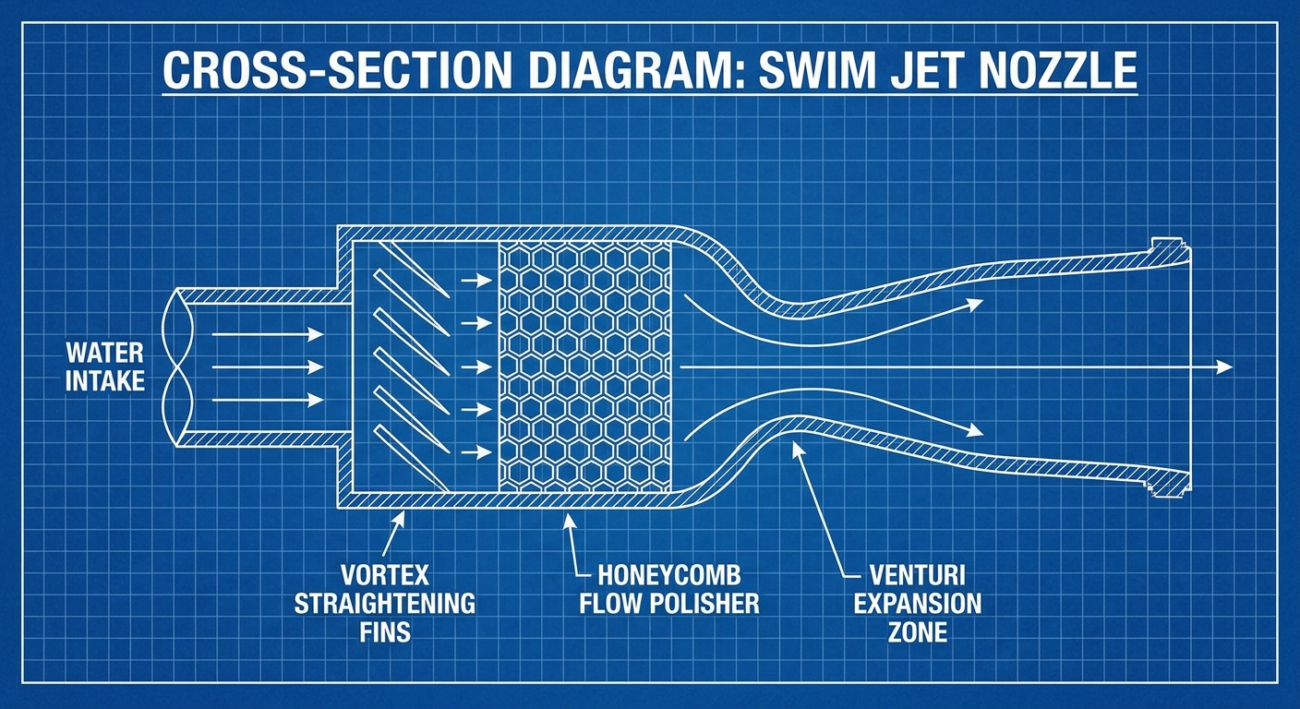
The fundamental goal of a swim jet, such as igarden swim jet X series is to replicate the sensation of swimming in open water. However, moving water through a narrow nozzle naturally generates turbulence, which can make the swim feel choppy and uneven. High-quality systems overcome this through a multi-stage process.
Stage 1: Water Intake and Acceleration
The process begins when the internal impeller spins at high RPM, drawing water from the pool through intake grilles. Inside the housing, the water becomes pressurised. In basic pumps, this pressurisation creates a vortex—a spinning, chaotic mass that would cause the swimmer to drift unpredictably.
Stage 2: Vortex Straightening
Professional-grade systems use internal fins to break up the vortex. As the water moves toward the exit nozzle, these fins force the spinning water into a straight path. Without this straightening step, the current would push the swimmer sideways or feel unstable.
Stage 3: Flow Polishing
Advanced swim jets incorporate a “flow polisher,” often a honeycomb-patterned grille located at the front of the jet.
As water passes through these tiny hexagonal channels, any remaining micro-turbulence is smoothed out.
The result is laminar flow—a thick, transparent, and predictable column of water that provides consistent resistance across the swimmer’s body.
Stage 4: Volume Enhancement via the Venturi Effect
To create a wide swim lane rather than a narrow jet stream, engineers use the Venturi effect.
By tapering the internal nozzle, the velocity of the water increases.
As this high-speed water exits, it creates a low-pressure zone that pulls in additional surrounding pool water.
This increases the total volume of the current, making it wide enough to cover the swimmer’s entire body and preventing the “sinking” feeling common in lower-quality jets.
Training, Therapy, and Family Fun
Swim jets serve a variety of purposes beyond simple lap swimming.
For triathletes and fitness swimmers, the ability to swim without turning every 10 to 15 metres helps maintain a consistent heart rate and focus on stroke technique.
Many systems offer multiple speed settings—some up to eight levels—allowing users to warm up gently, perform high-intensity intervals, or cool down.
The steady, laminar current also supports low-impact resistance training for joint rehabilitation and muscle recovery.
Families enjoy the playful challenge of swimming against the current, and children can build water confidence in a controlled environment.
Choosing and Maintaining a Swim Jet System
When selecting a swim jet for your pool, consider factors such as maximum flow rate, power consumption, and installation compatibility.
Modern systems use energy-efficient inverter-driven motors that adjust speed automatically, extending component life and reducing noise.
Installation options include built-in setups for new pools and retrofit kits for existing pools—many requiring no external pumps or plumbing.
Maintenance is straightforward: keep the intake grille free of debris, monitor water chemistry (pH between 7.0 and 7.8, salt below 0.4%), and ensure the control box is installed in a dry, ventilated area.
In colder climates, follow the manufacturer’s decommissioning steps to prevent ice damage.
Conclusion
Swim jets offer a practical way to turn any home pool into a versatile training and recreation hub.
By understanding how these systems generate a smooth, adjustable current, homeowners can choose the right model for their needs and enjoy years of efficient, enjoyable swimming.
Whether for serious fitness, gentle therapy, or family play, a quality counter-current system delivers consistent performance with minimal upkeep.
