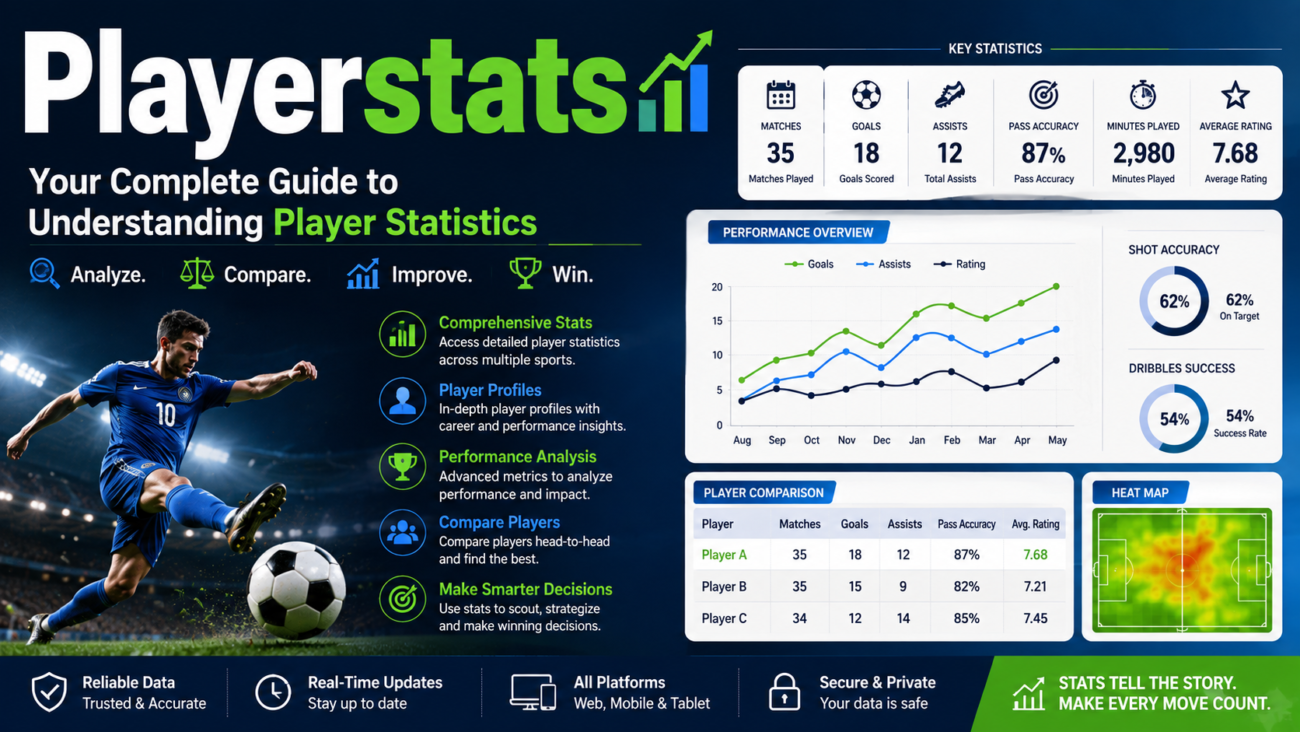
In the world of sports, numbers tell a story. Whether you follow football, basketball, baseball, cricket, hockey, or another competitive sport, Playerstats provide valuable information about how athletes perform. Player statistics help fans, coaches, analysts, fantasy players, and sports organizations understand individual performances and compare athletes based on measurable results.
With modern technology, player statistics are easier to access than ever before. Instead of relying only on match reports or television commentary, sports fans can explore detailed statistics covering everything from points and goals to assists, appearances, shooting percentages, defensive actions, and many other performance indicators.
What Are Playerstats?
Playerstats refers to statistical information about an individual athlete’s performance. These statistics can be collected during a single game, across a season, or throughout a player’s career.
The exact statistics available depend on the sport. For example, basketball player statistics may include points, rebounds, assists, steals, blocks, and shooting percentages. Football statistics can include goals, assists, appearances, shots, passes, tackles, and minutes played.
Player statistics can be presented in simple tables or detailed databases. The purpose is generally the same: to provide an objective way to understand a player’s contribution and performance.
Why Are Playerstats Important?
Player statistics are important because they turn athletic performance into measurable information. Watching a game can provide an impression of how well someone performed, but statistics can add another layer of understanding.
For fans, playerstats make it easier to follow favorite athletes and discover emerging talent. Coaches can use statistical information to identify strengths and weaknesses. Analysts can examine trends and compare players across different periods.
Statistics are also particularly useful for fantasy sports. Fantasy players often use recent and historical performance data to make decisions about which athletes to select for their teams.
Types of Playerstats
Different sports use different statistical categories. Some of the most common types include:
- Basic statistics: Games played, appearances, minutes, points, goals, or runs.
- Scoring statistics: Goals, points, touchdowns, baskets, runs, or other scoring contributions.
- Passing statistics: Pass attempts, completed passes, assists, passing yards, and completion percentage.
- Defensive statistics: Tackles, interceptions, blocks, steals, clearances, and defensive rebounds.
- Shooting statistics: Shots attempted, shots made, shooting percentage, and shots on target.
- Advanced statistics: Efficiency ratings, expected goals, player impact metrics, advanced efficiency numbers, and other analytical measurements.
- Career statistics: A player’s accumulated performance over multiple seasons.
These categories allow users to examine different aspects of an athlete’s game rather than focusing on one number.
Playerstats in Football
Football, also known as soccer in some countries, uses a wide range of player statistics. Common statistics include appearances, minutes played, goals, assists, shots, shots on target, passes, passing accuracy, tackles, interceptions, and yellow or red cards.
Goalkeepers have their own important statistics, including saves, clean sheets, goals conceded, and save percentage.
Modern football analysis also uses advanced metrics. Expected goals (xG), expected assists (xA), progressive passes, key passes, and successful pressures can help explain performances that traditional statistics may not fully capture.
For example, a midfielder may not score many goals but could still have a major influence through passing, chance creation, ball recovery, and progression.
Playerstats in Basketball
Basketball is particularly statistics-driven. Fans commonly examine points per game, rebounds, assists, steals, blocks, turnovers, and minutes played.
Shooting statistics are also important. Field-goal percentage, three-point percentage, and free-throw percentage help measure shooting efficiency.
Advanced basketball statistics can provide even more context. Metrics such as player efficiency, usage rate, offensive rating, defensive rating, and plus-minus are often used to evaluate overall impact.
Looking at several statistics together is generally more useful than judging a basketball player solely by points scored.
Playerstats in Baseball and Cricket
Baseball and cricket also have extensive statistical systems.
In baseball, important batting statistics include batting average, home runs, runs batted in, hits, on-base percentage, and slugging percentage. Pitchers can be evaluated through wins, earned run average, strikeouts, walks, and innings pitched.
Cricket statistics differ depending on whether a player is primarily a batter, bowler, or all-rounder. Batting statistics can include runs, batting average, strike rate, centuries, and fifties. Bowling statistics may include wickets, economy rate, bowling average, and strike rate.
Because these sports have long histories of statistical recordkeeping, fans can often compare modern athletes with players from previous generations.
How to Read Playerstats
Understanding player statistics does not always require advanced mathematical knowledge. Start by identifying what each statistic measures.
It is also important to consider the context. A player who scores 20 points in one basketball game may have performed differently from another player who averages 20 points over an entire season.
Similarly, a football striker’s goal total should be considered alongside appearances, minutes played, penalties, assists, and the quality of competition.
Percentages and averages can sometimes provide more useful information than raw totals. Always check the time period and number of games behind a statistic before making comparisons.
Playerstats and Player Comparisons
One of the most popular uses of player statistics is comparing athletes. Statistics can help answer questions such as who scores more, who creates more chances, who is more efficient, or who contributes more defensively.
However, comparisons should be made carefully. Players may have different positions, responsibilities, teammates, playing styles, and amounts of playing time.
For a fairer comparison, users can examine statistics per game, per 90 minutes, or another standardized measure when appropriate.
Combining traditional and advanced statistics can also provide a more complete picture of player performance.
Benefits of Following Playerstats
There are several benefits to regularly following player statistics:
- Better understanding of performance: Statistics reveal patterns that may not be obvious while watching games.
- Easy player comparisons: Fans can compare athletes using consistent measurements.
- Historical research: Career statistics make it possible to study players across different seasons.
- Fantasy sports decisions: Statistics can support roster and lineup decisions.
- Sports analysis: Coaches, journalists, and analysts can use data to develop deeper insights.
- Tracking improvement: Season-by-season numbers can show whether a player’s performance is improving or declining.
Limitations of Playerstats
Although statistics are valuable, they do not tell the entire story.
Some contributions are difficult to measure. A football player’s positioning, communication, or movement away from the ball may be extremely important without appearing clearly in a basic statistics table.
Team tactics can also affect individual numbers. A player operating in a defensive role may naturally have fewer scoring opportunities than an attacking teammate.
Therefore, playerstats should ideally be combined with video analysis, expert opinions, tactical context, and knowledge of the sport.
The Future of Playerstats
The future of player statistics is likely to become increasingly sophisticated. Advances in tracking technology, artificial intelligence, and data analysis are making it possible to measure more aspects of athletic performance.
Wearable devices and tracking systems can provide information about movement, speed, workload, positioning, and physical activity. Advanced analytical models can then process this information to produce new performance metrics.
As sports technology develops, fans may gain access to increasingly detailed information about how players perform during every stage of a game.
Conclusion
Playerstats have become an essential part of modern sports. They help fans understand athletes, support professional analysis, enable meaningful comparisons, and provide historical records of sporting achievement.
From goals and assists in football to points and rebounds in basketball, runs and wickets in cricket, and batting and pitching statistics in baseball, player statistics provide a structured way to examine performance.
The most effective approach is not to rely on one statistic alone. Instead, consider multiple metrics together and always account for context. When used correctly, playerstats can make watching and understanding sports more informative, engaging, and enjoyable.
